Pandémie de Covid-19 : le virus circulait sans doute en France dès novembre 2019
Les résultats des travaux de chercheurs français mettent à mal l’hypothèse d’un départ de l’épidémie sur le marché chinois de Wuhan au début du mois de décembre 2019.
Par Stéphane FoucartPublié le 10 février 2021 à 10h18 – Mis à jour le 10 février 2021 à 17h24
https://www.lemonde.fr/planete/article/2021/02/10/le-sars-cov-2-circulait-sans-doute-en-france-des-novembre-2019_6069431_3244.html
Temps de Lecture 4 min.
Interpellés par plusieurs cas cliniques ayant précédé l’épidémie de Covid-19, des médecins de l’hôpital Albert-Schweitzer de Colmar (Haut-Rhin) réanalysaient, en mai, plusieurs centaines de scanners thoraciques de patients admis dans leur établissement dès octobre 2019, pour des pneumopathies sévères. Un de ces malades, hospitalisé le 16 novembre, était porteur de lésions évocatrices du Covid-19. Une présence du nouveau coronavirus sur le territoire français était dès lors suspectée à cette date, mais sans analyse de prélèvements biologiques, l’hypothèse demeurait fragile. Des travaux de chercheurs français publiés samedi 6 février dans la revue European Journal of Epidemiology viennent appuyer ces observations : ils indiquent, avec un haut niveau de preuve, que le SARS-CoV-2 circulait déjà en France en novembre 2019.
« Ces résultats suggèrent que dès novembre et décembre 2019, le taux de contamination en France est déjà de l’ordre d’un cas pour mille », le professeur Fabrice Carrat
Les chercheurs, conduits par le professeur Fabrice Carrat, directeur de l’Institut Pierre-Louis d’épidémiologie et de santé publique (Inserm, Sorbonne Université), ont procédé avec un soin particulier. Ils ont analysé 9 144 échantillons sanguins collectés sur des participants à la cohorte « Constances » – la plus grande cohorte épidémiologique suivie en France, forte de plus de 200 000 individus, lancée en 2012 grâce au programme des investissements d’avenir. Ils les ont d’abord passés au crible d’un test rapide détectant des immunoglobulines de type G (IgG) anti-SARS-CoV-2. Ce test étant réputé générer des « faux positifs », les auteurs ont confirmé ou infirmé la mesure grâce à un second test, très spécifique, mais plus délicat à mettre en œuvre.
Lire aussi : Du premier cas détecté de Covid-19 au déconfinement, la chronologie d’une crise mondiale
Résultats : sur les 9 144 échantillons analysés, treize prélevés entre novembre et janvier se sont révélés positifs aux deux tests, dont dix prélevés en novembre ou décembre. « Nous avons commencé par analyser des échantillons prélevés en janvier et février, et nous en avons trouvé bien plus de positifs que ce à quoi nous nous attendions, explique l’épidémiologiste Marie Zins (Inserm, université de Paris), principale investigatrice de la cohorte “Constances”. Nous avons donc cherché à voir si nous en trouvions dès l’automne. »
13 cas positifs entre novembre et janvier
Pour M. Carrat, « ces résultats suggèrent que dès les mois de novembre et décembre, le taux de contamination dans la population française est déjà de l’ordre d’un cas pour mille ». « Ces résultats ne montrent pas de surreprésentation de la maladie dans certaines régions, ajoute M. Carrat. On semble trouver des cas de manière sporadique, un peu partout sur le territoire. »
Jusqu’à présent, le premier cas français de Covid-19 confirmé par test PCR est un patient hospitalisé pour une pneumopathie sévère, fin décembre 2019, en Seine-Saint-Denis, et dont les prélèvements, congelés, avaient été réanalysés en avril 2020 à l’initiative des professeurs Yves Cohen et Jean-Ralph Zahar (hôpital Avicenne, à Bobigny).
Parmi les treize cas positifs entre novembre et janvier, onze ont en outre répondu à un questionnaire adressé par Santé publique France – qui a cofinancé ces travaux – pour mettre en évidence des facteurs de risque ou une éventuelle association avec des symptômes caractéristiques du Covid-19, chez l’intéressé ou l’un de ses proches. Une femme d’une trentaine d’années, positive en novembre, a expliqué que son partenaire avait souffert d’une toux intense en octobre. Une autre, ayant voyagé en Espagne début novembre, a été en contact avec un membre de sa famille ayant souffert d’une pneumonie d’origine inconnue entre octobre et décembre.
Voyages ou contacts avec des malades
« Dans plus de la moitié des cas, on a affaire à des gens qui ont voyagé ou qui ont été en contact avec des personnes ayant été malades, dit M. Carrat. L’un des cas avait voyagé deux mois en Asie et est revenu début décembre en France… un autre est médecin, ce qui est aussi un facteur de risque. » Un grand nombre d’échantillons sanguins étant collectés de manière routinière, depuis 2018, sur les membres de la cohorte « Constances », les chercheurs pourraient tenter de remonter plus loin encore dans le temps. « La question que nous nous posons désormais, c’est de savoir si le virus était déjà en France en septembre et pourquoi pas en août, explique Mme Zins. Nous cherchons les financements pour mener les analyses nécessaires. »
En attendant, ces résultats confortent d’autres travaux italiens suggérant que les premiers cas d’infections par le nouveau coronavirus remontaient, en Italie, au mois d’octobre 2019. Ces travaux avaient été publiés en novembre 2020 dans le Tumori Journal, mais la méthodologie mise en œuvre avait été jugée fragile par plusieurs spécialistes, alors interrogés par Le Monde.
Ces indices d’une circulation déjà soutenue du nouveau coronavirus en Europe dès les mois de novembre, voire d’octobre, mettent à mal l’hypothèse d’un départ de l’épidémie sur le marché de Huanan, à Wuhan, en Chine, au début du mois de décembre 2019. Toutefois, ils ne permettent pas de remettre en cause les connaissances acquises sur la phylogénie du virus – les souches du SARS-CoV-2 circulant actuellement dans le monde dérivant toutes d’un virus apparu vers septembre-otobre 2019, dans la province chinoise du Hubei.
Lire aussi La Chine, grande gagnante de la mission d’enquête de l’OMS sur les origines du Covid-19
Evidence of early circulation of SARS-CoV-2 in France: findings from the population-based “CONSTANCES” cohort
- Fabrice Carrat,
- Julie Figoni,
- Joseph Henny,
- Jean-Claude Desenclos,
- Sofiane Kab,
- Xavier de Lamballerie &
- Marie Zins
https://link.springer.com/article/10.1007/s10654-020-00716-2
Abstract
Using serum samples routinely collected in 9144 adults from a French general population-based cohort, we identified 353 participants with a positive anti-SARS-CoV-2 IgG test, among whom 13 were sampled between November 2019 and January 2020 and were confirmed by neutralizing antibodies testing. Investigations in 11 of these participants revealed experience of symptoms possibly related to a SARS-CoV-2 infection or situations at risk of potential SARS-CoV-2 exposure. This suggests early circulation of SARS-CoV-2 in Europe.
Introduction
The first identified cases of COVID-19 were detected on December 8, 2019, in Wuhan, China and the first documented case in Europe was reported retrospectively in France in one patient with a diagnosis of pneumonia and a positive SARS-CoV-2 RT-PCR result on December 27, 2019 [1]. By April 4, 2020, local community transmission was reported in all continents and over 1 million cases of COVID-19 had been confirmed worldwide. Although dedicated surveillance and contact tracing did not identify local transmission before the second half of February in Europe, there is accumulated evidence that SARS-CoV-2 circulated in early January 2020 in the East of France [2] and environmental studies suggest that the virus could have been present in December 2019 in Northern Italy [3]. A recent investigation of the presence of SARS-CoV-2 antibodies in 959 adults participating to a trial in Italy with blood samples collected between September 2019 to February 2020 identified 111 (11.6%) samples with a positive receptor-binding protein specific enzyme-linked immunosorbent assay (ELISA), among which 4 samples collected in October, 1 in November and 1 in February were also positive in a qualitative microneutralization assay [4]. This indicates that SARS-CoV-2 could have been present in Italy since the beginning of autumn 2019. However, information on antibody responses at the early stage of the SARS-CoV-2 spread in other European countries or worldwide remains scarce.
Participants and methods
We explored the serological status for SARS-CoV-2 antibodies in participants from the “CONSTANCES” cohort. Briefly, CONSTANCES is a general population-based cohort made up of a nationwide representative sample of 215,000 adults aged 18 to 69 at inclusion. Inclusion started in 2012, and serum samples are regularly collected during the follow-up of participants for future analyses and stored in a centralized biobank. A complete description of the cohort design can be found in [5]. The cohort received ethical approval and all participants provided written consent to the cohort and additional consent to the current study.
We selected all 9144 serum samples collected between November 4, 2019 and March 16, 2020 in participants living in the 12 mainland French regions. All samples were centralized to the virology laboratory (Unité des virus Émergents, Marseille, France) for serological analysis. The serological analysis was performed using a commercial Elisa test (Euroimmun®, Lübeck, Germany) to detect anti-SARS-CoV-2 antibodies (IgG) directed against the S1 domain of the spike protein of the virus (ELISA-S). In accordance with the manufacturer’s instructions a test was considered to be ELISA-S positive with an optical density ratio ≥ 1.1, indeterminate between 0.8 and 1.1, and negative, < 0.8. All samples with an ELISA-S test ≥ 0.7 were also tested with an in-house micro-neutralization assay to detect neutralizing anti-SARS-CoV-2 antibodies (SN), as described elsewhere [6]. A SN titer ≥ 40 was considered to be positive. Six replicates were performed to confirm positive SN.
Participants with both ELISA-S and SN positive tests in serum sampled before February 1, 2020 were interviewed to identify potential exposure to SARS-CoV-2 infection. A trained investigator collected standardized information on clinical details (in the participant and her/his relatives), history of possible exposure (notably history of travel in Asia), and any remarkable event in close contacts (e.g. unexplained pneumonia).
Results
Participants were aged 55 (min: 19, max: 79) years at sample collection; 4623 (51%) were female; 1503 (16%) were living in Ile de France, 935 (10%) in Grand-Est—these two regions being the French regions with the highest incidences of hospitalization for COVID-19 during the first semester 2020, 6706 (73%) were living in the other 10 mainland regions.
Three-hundred and fifty-three (3.9%) participants were ELISA-S positive, 138 were undetermined and 8653 were negative (undetermined and negative, 96.1%). The proportion of ELISA-S positive increased from 1.9% (42 of 2218) in November and 1.3% (20 of 1534) in December to 5.0% (114 of 2268) in January, 5.2% (114 of 2179) in February and 6.7% (63 or 945) in the first half of March (P < 0.001, Trend test; Fig. 1).
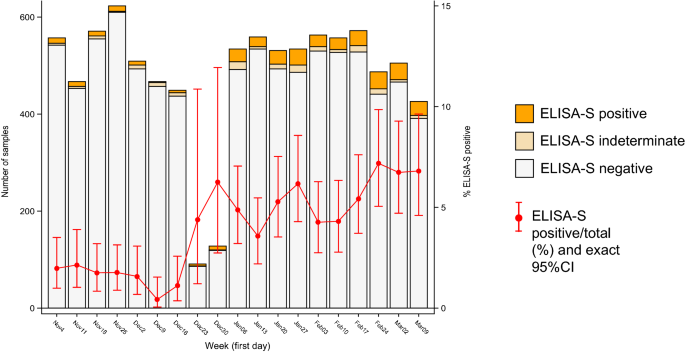
Number of blood samples tested each week for anti-SARS-CoV-2 antibodies by ELISA-S IgG test (horizontal bars) and percentages of ELISA-S positive test (red dots, with exact 95% Confidence Interval) in adult participants from the CONSTANCES cohort, France
Neutralizing antibodies were detected in 44 (0.48%) participants (23 with a titer of 40, 12 with a titer of 80, 9 with a titer of 160), were undetermined in 15 participants, negative in 498 and not done in 8597 (Fig. 2). Strikingly, 13 participants with positive ELISA-S and SN tests had been sampled between November 5, 2019 and January 30, 2020. Table 1 describes the serological results in these 13 participants, among whom 11 were interviewed. Six of those interviewed did not report any symptom during the weeks preceding the sample collection. Five participants experienced signs of viral respiratory illnesses, and 8 had close contact with persons who exhibited such signs or reported situations at risk of potential SARS-CoV-2 exposure. Of note, participant #7 who was tested positive on Nov 29, 2020 had a second serological sample collected in July 2020 with a positive ELISA-S test and negative SN test—this participant also tested positive in SARS-CoV-2 RT-PCR in September 2020 for new symptoms suggesting a possible reinfection.
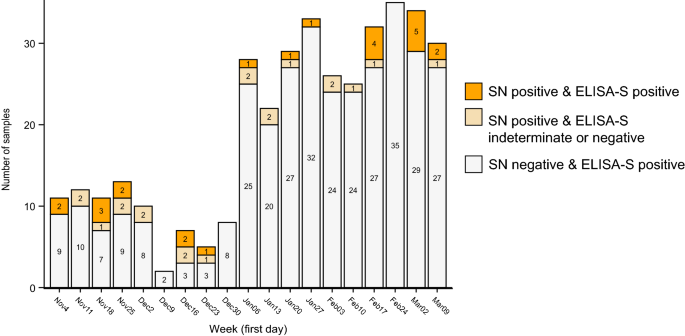
Participants with a positive ELISA-S or a positive SN anti-SARS-CoV-2 test in the CONSTANCES cohort
https://link.springer.com/content/pdf/10.1007/s10654-020-00716-2.pdf
Unexpected detection of SARS-CoV-2 antibodies in the prepandemic period in Italy
Show all authorsGiovanni Apolone*, Emanuele Montomoli*, Alessandro Manenti, …First Published November 11, 2020 Research Article Find in PubMedhttps://doi.org/10.1177/0300891620974755
Abstract
There are no robust data on the real onset of severe acute respiratory syndrome coronavirus 2 (SARS-CoV-2) infection and spread in the prepandemic period worldwide. We investigated the presence of SARS-CoV-2 receptor-binding domain (RBD)–specific antibodies in blood samples of 959 asymptomatic individuals enrolled in a prospective lung cancer screening trial between September 2019 and March 2020 to track the date of onset, frequency, and temporal and geographic variations across the Italian regions. SARS-CoV-2 RBD-specific antibodies were detected in 111 of 959 (11.6%) individuals, starting from September 2019 (14%), with a cluster of positive cases (>30%) in the second week of February 2020 and the highest number (53.2%) in Lombardy. This study shows an unexpected very early circulation of SARS-CoV-2 among asymptomatic individuals in Italy several months before the first patient was identified, and clarifies the onset and spread of the coronavirus disease 2019 (COVID-19) pandemic. Finding SARS-CoV-2 antibodies in asymptomatic people before the COVID-19 outbreak in Italy may reshape the history of pandemic.
Keywords Screening, COVID-19, SARS-CoV-2 antibodies
https://journals.sagepub.com/doi/pdf/10.1177/0300891620974755
 Santé-Environnement-Politique